
Nicola Henriques, LCCH
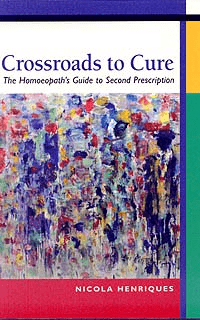
Crossroads to Cure: The Homeopaths Guide to Second Prescription by NICOLA HENDRIQUES
$29.99
Description
Book Review
[From Homoeopathic Links Summer 1999 – Volume 12, Number 2]
This book review is reprinted with permission from Homeopathic Links.
Crossroads To Cure: The Homoeopath’s Guide To Second Prescription
Nicola Henriques
Reviewed by Ernest Roberts, England
This book is a landmark in our progress to establishing a consensus as to what homoeopathy is and what it can achieve. It is not a perfect book but it is a valuable, thoroughly researched exposition of homoeopathy which I predict will bring to many homoeopaths a ‘higher’ ideal of cure. A quality of the book is the skillfull modern style of writing which in itself is worth commending. The origins of homoeopathy in German then American and the exigencies of many translations of the main sources has often led to poorly expressed and sometimes confusing literature. Here is a clear concise modern book with literary merit.
Chapter One reiterates the basic principles of homoeopathy with reference to when their correct understanding is important in considering the second prescription. This chapter would benefit reading by even experienced practitioners for its brevity, clarity and completeness. Chapter Two covers the follow-up interview.
Chapter Three reviews possible changes after the first prescription (signs of change), these may be curative, suppressive, palliative or ineffectual, each of these responses are explored clearly. A useful exploration of the unprejudiced observer and a detailed guide of how to conduct the second interview are included. The distinction between ‘what is a reaction’ and ‘what calls for a remedy’ begins the considerations necessary for the second prescription. Chapter Four divides into two parts.
1. Those reactions to a first prescription which are favourable and what to do.
2. Those reactions which appear to be unfavourable or problematic. This part of the book is most interesting as this area gives most difficulties and where errors can be made. This section will reward careful study from even experienced prescribers. There is much clear and useful advice as to potency and repetition of dose. Emphasis is placed on plussing or use of LM’s so as to change slightly the potency when it is deemed necessary to repeat. Also some practical advice for example when after a prescription only local symptoms remain, this is to ‘select a rubric that more closely reflects the persistent local symptom’, e.g. choose ‘Stomach nausea, noise from’, rather than ‘Mind sensitive noise to’. I would refer the reader to Robin Logan’s book: ‘The Homoeopathic Treatment of Eczema’, where more examples of these skills are given. This leads onto the coverage of the relationship of remedies and acutes of chronics (Cognates), which is clearly given. Discussion of how a case may be confused is clear, especially on page 106. In the second part of chapter four on difficult reactions, guidance is given on ‘too short an amelioration’, ‘prolonged initial aggravation’, ‘aggravation of organic pathology’, ‘incorrect direction of cure’, ‘no change of symptoms’, ‘overreaction’ and ‘appearance of new symptoms’. There is a brief discussion of cases with allopathic drug use on page 138. I consider this brevity a serious omission although it has been covered fairly well elsewhere in S. Gascoigne ‘Prescribed Drugs for the Alternative Practitioner.’ I would suggest that there is a real need for some detailed discussion of complexities in today’s practice which require special treatment, for example of cases of cancer, epilepsy; and AIDS etc. which practitioners using homoeopathic remedies experimentally claim fall outside homoeopathic principles. It is important that classical homoeopathy shows how to approach such cases effectively according to law and to explain how to decide on curability and palliation in such cases.
Chapter five is an exegesis of the LM potencies. As with the rest of the book this topic is thoroughly researched and manages to remove all confusion’s, doubts and conflicts which I have heard expressed about the LM range. This chapter should remain the definitive explanation of these potencies and their use for some time.
Chapter six indicates when to change the remedy. This chapter gives excellent and sound homoeopathic practice. A few minor caveats only, in chapter four; word ‘scenario’s page 84 is used to describe the several different adverse reactions, the word is not used again until page 101 when the reader may be excused for feeling puzzled. The word is excellent but I suggest it is repeated on the heading of each scenario and numbered, there are nine such ‘scenarios’. Secondly there are rather too many quotes from the masters, some are repetitive and there is throughout the book a tendency to be repetitive.
My final observations about this milestone volume is a general one. Throughout the book and especially in chapters six and seven there is an intense preoccupation with the idea of ‘waiting’. In the first euphoric years of the rediscovery of homoeopathy in the seventies there was a plethora of enthusiastic over prescribing; new nosodes, new ideas, new. experiences abounded. This book represents a swing of the pendulum. There was a lot of good prescribing and practice in those early years but the main failing was undoubtedly too hasty changes of prescriptions and not waiting (purposefully) long enough. There is an undoubted need for this book’s emphasis on waiting and the correct explanation of how and why and for what we wait. The danger of too extreme a swing is in waiting long after a prescription is required and I have seen this happen especially in difficult cases with strong gross pathology like cancer when the one simillimum or constitutional remedy was adhered to as the patient declined, losing weight, and patently requiring a deeper acting or more acute remedy to deal with the situation. As discussed above a more explicit treatment of complex, drugged and cases of gross pathology along the lines taught by Hahnemann and his faithful followers is required. This book gives, so to speak, the ground rules for most of our practice. The growing number of extremely complex cases requires perhaps a second book showing how the principles and practice of homoeopathy can correctly cope with these cases. (On page 137 dealing with the appearance of new symptoms the author says, ‘…the first case analysis did not cover the complete totality of the individual’s suffering’ and ‘To complete cure patients often require a series of carefully selected remedies.’ In cases with several layers of predisposition, it may be impossible in theoretical work to teach how to select the first correct remedy and the subsequent ones; perhaps only case examples can do this. However the refined model of layers, based on the Organon, by George Vithoulkas goes a good way to begin this understanding. (1).
The future hope of homoeopathy becoming the main form of medical practice is harmed by two groups of homoeopaths those who being unable to comprehend and learn skilfully how to do it properly seek to denigrate good practice by caricature. The second group are devotees of Classical Homoeopathy who fail to listen to those seeking to understand, these protagonists do not listen and therefore cannot teach homoeopathy to those who seek it, this has led to a false and unnecessary polarity. This was in evidence strongly during the questions following the presentation by Mrs. S. Creasey at the Society of Homoeopaths Conference in 1998. I hope this book will be welcomed generally as a help to foster an honest search by all homoeopaths for a consensus of homoeopathic practice according to natural law and able to clearly treat appropriately all patients, and take us away from controversy.
(1) As far as I know this is as yet unpublished but has been taught at Alonissos, a brief review of this model has been sent to Homoeopathic Links by myself in an article about The Academy of Classical Homoeopathy at Alonissos.
You must be logged in to post a review.


Reviews
There are no reviews yet.