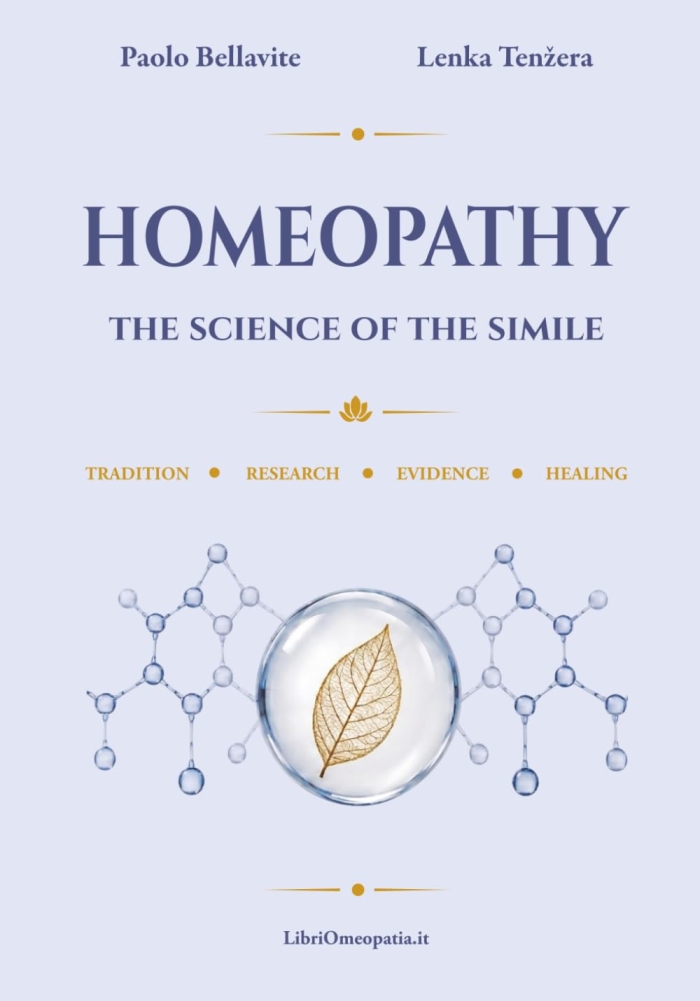
Homeopathy – the Science of the Simile by Paolo Bellavite, MD, and Lenka Tenzera, MD
THIS NEW BOOK IS EXPECTED TO ARRIVE AROUND NOVEMBER 11TH, 2026. IF YOU ORDER OTHER ITEMS AT THE SAME TIME, WE WILL DELAY SHIPPING SO THAT THEY CAN BE SHIPPED…
THIS NEW BOOK IS EXPECTED TO ARRIVE AROUND NOVEMBER 11TH, 2026. IF YOU ORDER OTHER ITEMS AT THE SAME TIME, WE WILL DELAY SHIPPING SO THAT THEY CAN BE SHIPPED TOGETHER, UNLESS YOU REQUEST A 2nd SEPARATE SHIPPING COST.
Homeopathy has systematically organized and formalized observed medical phenomena according to the principle of “similarity” and the use of extremely low doses or highly diluted/succussed medicines. For over two centuries, this medical specialty has inspired practitioners worldwide, while also raising criticism about the plausibility of its principles. Scientific and technological advancements, however, have begun to stimulate new interest and expansion within medical circles.
This book, rigorously scientific and supported by over a thousand bibliographical references, addresses the rational foundations of homeopathy and updates the experimental research conducted in recent decades. It is intended for both homeopaths who wish to deepen the scientific basis of their practice, and for all medical professionals, as it presents the important topic following the criteria of 21st-century medicine.
The text is introduced by the illuminating prefaces by Raj Kumar Manchanda (India), Antonella Ronchi (Italy) and Leoni Bonamin (Brazil) and is divided into four sections: (I) founding principles and their historical divergence from conventional medicine; (II) laboratory evidence of high-dilution effects and paradoxical pharmacology; (III) clinical evidence in various fields and (IV) conceptual models of the Simile in the context of complex systems theory.
404 pages

Paolo Bellavite
Paolo Bellavite graduated in medicine in 1976 from the University of Trieste (I), where he began his research and teaching activities. He specialized in hematology, received a master’s degree in biotechnology from Cranfield University (UK), and an advanced degree in health statistics and epidemiology. He worked as a Professor of General Pathology at the University of Verona, then teaching assistant and principal investigator until 2021. He currently continues his scientific activity as an independ-ent researcher and a teacher at the Homeopathic Medicine School of Verona. Bellavite and his group have developed studies on molecular, cellular, and pharmacological aspects of inflammation, free radical formation and toxicity, platelet function and regulation. He has also developed the scientific research in complementary medicine, on the effects of natural compounds in biological systems, on high-dilution pharma-cology (scientific aspects of homeopathy), nutraceutics, and vaccinology. Bellavite is a member of the International Study Group on the Effects of Very Low Doses (GIRI), of ContiamoCi Association, and of the Italian Federation of Homeopathic Associa-tions and Doctors (FIAMO). As of June 2026, 177 scientific papers that he authored are cited in the PubMed database, and his Hirsch Index is 56 (Google Scholar).

Lenka Tenžera
Lenka Tenžera graduated in Medicine in 2005 from the University of Niš. Following her graduation, she worked at the Clinic for Cardiovascular Surgery of the Institute for Cardiovascular Diseases of Vojvodina in Sremska Kamenica and enrolled in post-graduate studies in the field of surgery. For personal reasons, she discontinued her surgical specialization and devoted herself to the study of homeopathic medicine, where she found a deeper understanding of the human organism, its health, and dis-ease. She completed a three-year program in homeopathic medicine at the Interna-tional Academy of Classical Homeopathy under Professor George Vithoulkas. Upon graduation, she received authorization from the Ministry of Health of the Republic of Serbia to apply this method in patient treatment. Since 2021, she has been enrolled in doctoral academic studies in Medical Sciences at the Faculty of Medicine, University of Niš. After a decade of experience in homeopathic treatment, she founded the first homeopathic school in Belgrade, Republic of Serbia—the Centre for the Develop-ment of Homeopathic Medicine—organized on academic principles. The Centre is currently enrolling its third generation of medical doctors. She has published three papers in peer-reviewed journals to date. She also translated and published in Serbian the book Science of Homeopathy by George Vithoulkas.
Comments about this book from highly respected physicians and homeopaths!
More from Research Books


„Professor Paolo Bellavite is an astute academician and researcher whose scholarship has
consistently reflected intellectual honesty, persistence, and a deep respect for scientific inquiry.
His engagement with homeopathy has been steady and thoughtful over the years, and this book
reflects that lifelong commitment. It represents a substantially revised and expanded evolution of
an earlier work, enriched by further research, reflection, and new perspectives.
The book, written with the excellent cooperation of Dr. Lenka Tenžera, is organized in a manner
that will be especially useful to students, teachers, researchers, and even clinicians. Its
progression—from the historical development of medical thought, through experimental and
preclinical investigations, to clinical application and epistemological reflection—offers readers a
structured and coherent approach to homeopathy. This is particularly important in a field where
relevant material is often scattered and difficult to access in one place.“
Raj Kumar Manchanda
Dr Raj Kumar Manchanda, M.D., MBA (Health care)
Chairperson, Homoeopathy Sectional Committee, Ayush Department, Bureau of Indian Standards,
Government of India.
Special Secretary for Public policy and Organizational development, Liga Medicorum Homoeo
pathica Internationalis.
Former Director General, Central Council for Research in Homoeopathy, Ministry of Ayush, Gov
ernment of India.
Former Director, Directorate of Ayush, Government of Delhi, India.
admin –
„This book, carefully written and organized by Paolo Bellavite and Lenka Tenzera, is a
journey through the different aspects that make up the universe of homeopathy and
dynamized high dilutions. It begins by describing key elements of the history of
homeopathy, from the beginning of the 19th century to the formulation of modern
hypotheses about the mechanisms of action, grounded in contemporary physical
concepts and the emerging properties of polar solvents, especially water… This conceptual journey, richly illustrated with experimental data from cutting-edge
publications, aligns with the objectives of the first scientific society created to bring
together researchers interested in homeopathy and high dilutions: the GIRI (Groupe
International de Recherche sur l’Infinitésimal), founded in France in 1986. I have been a
member of GIRI since 1998 and served as its president between 2002 and 2008.
Therefore, I am honored to see in this book a synthesis of everything discussed at our
annual meetings, which has always prioritized the practice of “thinking collectively and
collaboratively.” The GIRI has always been and always will be a laboratory of ideas, and
this book maintains the same profile. Themes such as reproducibility, the definition of
experimental controls, the plausibility of the homeopathic phenomenon, and the
construction of theories and hypotheses about the mechanisms of action involved are
reflected in this work.“
Leoni Villano Bonamin, DMV, Ph.D.
Full Professor at Universidade Paulista – UNIP – São Paulo.
Deputy Editor of “Homeopathy” – Thieme Publishers.
President of the GIRI between 2002 and 2008.
admin –
But above all, this book addresses the crisis faced by doctors when dealing with a patient
who is suffering from multiple chronic conditions, a circumstance that is becoming increas
ingly common as life expectancy rises. On this point, the Authors write: “Many pathologists
are convinced that most of diseases cannot be understood using the conventional, reduction
istic paradigm only. This is due to three reasons: a) most diseases are multifactorial pro
cesses, b) diseases are dynamic processes, and c) these phenomena involve the whole indi
vidual. These three levels of complexity claim for new attitudes of medicine, both in diag
nostics and in therapeutics”.
Even within the homeopathic community, however, there is an ongoing debate on how much
the management of a homeopathic patient is objective and how much it is a matter of inter
pretation instead. This stems from the fact that homeopathy, as a form of medicine, is both
a science and an art; in this regard, Bellavite and Tenžera state: “Homeopathy is therefore a
complex method of diagnosis and of healing, which has various aspects dealing with pecu
liar traditional and philosophical background and other aspects dealing with the scientific
and rational bases of medicine.”
This dynamic will always exist, and a book such as this one can help us doctors to accept it
and manage it constructively for the benefit of our patients.
Dr. Antonella Ronchi MD
FIAMO President from 2002 to 2020, re-elected in 2026.
From 2009 to 2021 Coordinator of the Permanent Committee of Consensus and Coordination for
Non-Conventional Medicine in Italy.
With the European Committee of Homeopathy, she contributed to the drafting of the European Stan
dard UNI/EN 16872 concerning the services provided by doctors with additional competence.